China Top Explosion Proof LED Lights Suppliers

Choosing China’s top Explosion Proof LED Lights suppliers requires more than comparing prices or lumen claims. Industrial buyers need dependable performance in refineries, chemical plants, mines, grain facilities, and manufacturing sites. A light may look rugged. That does not prove safe construction.

John Bullough, a respected lighting researcher, has stated, “Visibility and safety must guide every lighting decision.” This principle matters in hazardous environments. Buyers should examine certification documents, protection methods, temperature ratings, ingress protection, and photometric reports. They should also confirm whether the product suits the required hazardous area classification. Small details matter. A loose cable gland can undermine a strong housing.

Experienced suppliers usually explain their testing process clearly. They can discuss aluminum housing quality, heat dissipation, lens durability, driver reliability, emergency options, and corrosion resistance. Their technical teams should answer practical questions without hiding behind marketing language. Site experience helps here. Dust, vibration, moisture, and frequent temperature changes can expose weaknesses that laboratory images do not show.

The best suppliers also provide traceable samples and realistic delivery information. Factory audits, inspection records, and after-sales support add confidence. Still, no supplier list is perfect. Specifications can change. Certificates require verification. Even an excellent lamp may fail when installed poorly.

This guide reviews leading Chinese manufacturers through a practical lens. It considers product quality, engineering capability, compliance awareness, customization, and service reliability. The goal is not to promote the loudest brand. It is to identify suppliers that can support safer, longer-lasting lighting decisions.

China Top Explosion Proof LED Lights Suppliers

Explosion-Proof LED Lights: Zones 0–2, 1–2, and 20–22

Choosing explosion-proof LED lights begins with the hazardous zone, not brightness. Zones 0–2 describe areas where flammable gas may exist continuously, frequently, or only briefly. Zone 0 demands the most restrictive equipment. Zones 1 and 2 still require certified protection, but exposure frequency differs.

Dust areas use Zones 20–22. A grain-processing room may face combustible dust every day, while a storage corridor may face it only during unusual conditions. Fine dust can enter weak seals. It can also collect on a hot housing. Look for suitable gas or dust certification, temperature ratings, impact resistance, and an appropriate IP rating. Check cable glands, mounting hardware, and emergency lighting compatibility. Small details matter.

A reliable supplier should provide traceable certificates, test reports, clear installation instructions, and replacement-part information. Ask whether the light matches the site’s gas group, dust group, and ambient temperature. Do not rely on appearance alone. A rugged aluminum body proves very little. In practice, zone drawings are sometimes outdated, and this creates selection mistakes. Reconfirm the area classification with a qualified safety professional before ordering. Periodic inspections should check seals, lenses, wiring, and surface temperature. The perfect fixture is rarely enough without careful installation.

China Top Explosion Proof LED Lights Suppliers — Explosion-Proof LED Lights: Zones 0–2, 1–2, and 20–22

This chart shows the minimum Equipment Protection Level (EPL) generally associated with hazardous-area zones under IEC 60079 classification. The index is used only to visualize the protection hierarchy: 3 represents the highest level, while 1 represents the lowest level within the zones shown. Gas zones use the “G” designation, and dust zones use the “D” designation.

Zone 0 and Zone 20 require Ga and Da equipment respectively; Zone 1 and Zone 21 require Gb and Db; Zone 2 and Zone 22 require Gc and Dc. Final LED luminaire selection must also consider gas or dust group, temperature class, ambient conditions, ingress protection, installation method, and local certification requirements.

China Supplier Compliance: IEC 60079, IECEx, ATEX, and GB 3836

China's explosion proof LED light suppliers must prove more than brightness and housing strength. Compliance begins with the hazardous area.

Buyers should identify gas or dust risks, zone classification, equipment group, and temperature class. A suitable luminaire for Zone 1 may not suit Zone 2, dust environments, or every ambient temperature. Small details matter.

IEC 60079 provides the technical foundation for explosive atmospheres, including protection concepts, construction, testing, and installation. IECEx confirms assessment through an internationally recognized certification system. ATEX adds European market requirements, while GB 3836 sets China’s related national framework. These references are connected, but they are not interchangeable certificates. A reliable supplier should provide current certificates, test reports, marking details, and factory quality records. Check the certificate scope carefully. It should match the exact model, protection method, gas or dust group, and temperature class.

During technical reviews, I also compare cable entries, seals, enclosure materials, driver temperature, and photometric data. A certificate alone does not prove every installation is suitable. Site conditions still decide. Poor documentation is an early warning, even when the product looks robust.

Suppliers should answer traceability questions without vague promises. Batch identification, routine inspection, and change control deserve equal attention. One uncomfortable point remains: compliance checks can miss practical installation errors. That weakness should be discussed openly, then addressed through competent engineering review and commissioning records. Real reliability is built in the details.

Key Performance Data: 100–170 lm/W, IP66–IP68, and IK08–IK10

China Top Explosion Proof LED Lights Suppliers

Industrial buyers often compare explosion-proof LED luminaires by measurable performance, not catalogue language. Current high-efficiency products commonly deliver 100–170 lm/W, according to recent U.S. Department of Energy solid-state lighting research. This range can reduce energy use, but published efficacy may reflect laboratory conditions. Field results are usually lower.

That gap deserves attention.

Ingress protection is equally important. IEC 60529 defines IP66 as protection against dust and powerful water jets, while IP67 and IP68 address temporary or continuous immersion under specified conditions.

IK08–IK10 ratings, referenced by IEC 62262, indicate increasing resistance to mechanical impact. An IK10 housing can withstand 20 joules in the standard test. That sounds substantial. It is not indestructible.

Experienced suppliers should provide complete photometric files, thermal test records, salt-spray evidence, and independent certification documents. DOE reports repeatedly identify thermal management as a major factor in LED lifetime and maintained output. Therefore, a 150 lm/W claim means little without ambient-temperature data, driver details, and lumen-maintenance testing.

IP and IK ratings also do not prove hazardous-area compliance. Buyers should verify the applicable IECEx, ATEX, or local certification route for each installation. A supplier may offer excellent 100–170 lm/W performance yet still lack suitable evidence for a specific zone.

That is an uncomfortable, but necessary, check.

Supplier Evaluation: Factory Audit, LM-80, MOQ, Lead Time, and Warranty

China Top Explosion Proof LED Lights Suppliers

Supplier evaluation should begin with a factory audit, not a product catalogue. Verify production records, incoming-material inspection, calibration certificates, and traceability from LED module to finished luminaire. Check the actual hazardous-area certification, enclosure testing, cable glands, and thermal design. LM-80 is useful, but limited. It measures lumen maintenance for LED packages or modules under controlled conditions, not complete explosion-proof fixtures. Use LM-80 data with TM-21 projections, thermal measurements, and field evidence.

The U.S. Department of Energy notes that LED performance depends strongly on thermal management and operating conditions.

Ask for measurable commercial terms. A realistic MOQ should match your pilot volume, replacement needs, and packaging requirements. Very low MOQs may increase unit costs or reduce customization quality. Lead time should separate sample approval, component preparation, production, testing, and shipment.

The IEA reports that lighting consumes roughly 5% of global electricity, so efficiency claims deserve calculation, not attractive wording.

Request tested wattage, delivered lumens, power factor, and ambient-temperature limits. Warranty language needs careful reading. Confirm coverage period, failure thresholds, replacement procedure, freight responsibility, and excluded operating conditions. A five-year warranty sounds strong. It may be vague without failure-rate definitions.

Review factory audit findings annually, because processes change. One uncomfortable point remains: certificates can be genuine while everyday quality is inconsistent. Independent inspection before shipment is often worth the cost, especially for remote sites.

Mistakes still happen. A transparent supplier explains them quickly.

Industrial Use Cases: Oil & Gas, Chemicals, Mining, and Dust Hazards

China Top Explosion Proof LED Lights Suppliers

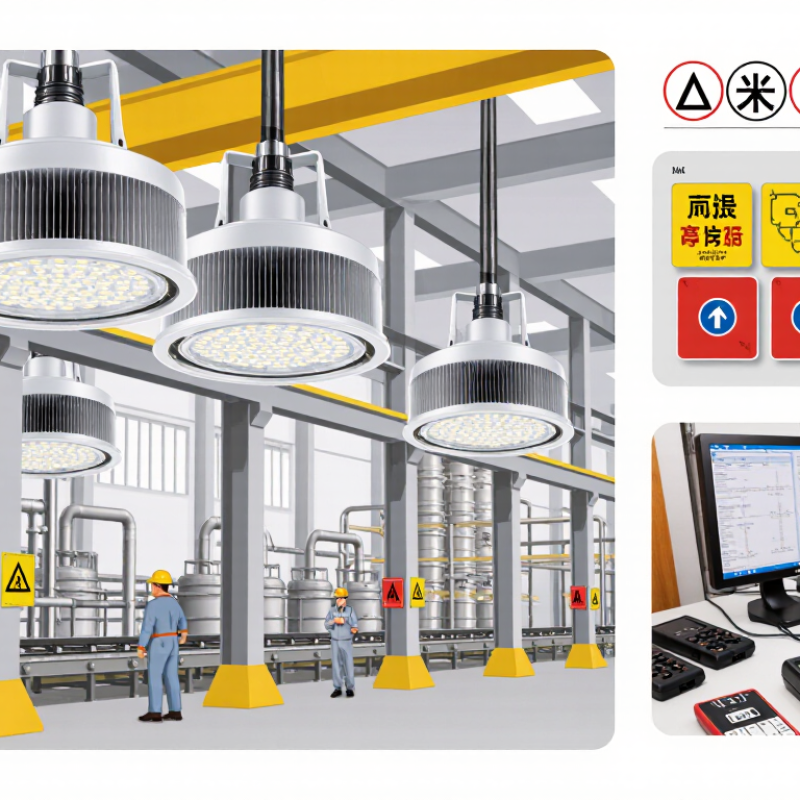
Industrial lighting must match the hazard, not merely brighten the workspace. In oil and gas facilities, vapors may collect around valves, pumps, and loading points. Chemical plants face corrosive gases and frequent washdowns. Mines add vibration, methane risks, and narrow travel routes. Dust hazards can appear in grain, food, wood, and metal-processing areas. A higher lumen number is not automatically safer.

The U.S. Department of Energy reports that LED lighting can use at least 75% less energy than incandescent lighting and last up to 25 times longer. That matters in plants operating around the clock. However, explosion-proof LED selection needs more than energy figures. Check hazardous-area classification, gas or dust group, temperature class, ingress protection, impact resistance, and certification under relevant IEC 60079 or local requirements. Thermal design also deserves attention. Poor heat control can shorten service life, especially in hot process rooms. Field inspections often reveal blocked lenses, loose glands, and unsuitable mounting angles. These details are easy to overlook.

Tips: Ask suppliers for complete test reports, not only certificates. Confirm emergency-lighting compatibility before installation. Compare illumination at floor level, not just rated lumens. Schedule cleaning inspections after dusty production cycles. I would also test one area first; real dust and vapor conditions can challenge assumptions.

China Top Explosion Proof LED Lights Suppliers - Industrial Use Cases: Oil & Gas, Chemicals, Mining, and Dust Hazards
Industrial Use Case Typical Hazardous Area Hazardous Material Recommended LED Light Configuration Typical Protection Requirements Key Selection Criteria Relevant Standards and Verification
Oil and Gas Processing Refineries, gas-processing units, pump areas, loading terminals, and compressor stations Flammable gases and vapors, including methane, hydrogen, propane, and hydrocarbon vapors
  • Explosion-protected high-bay or low-bay LED fixtures
  • Linear LED fixtures for pipe racks and process corridors
  • Floodlights for outdoor equipment and loading areas
  • IECEx or equivalent third-party certification
  • Common hazardous-area classifications: Zone 1 or Zone 2
  • Gas groups and temperature class selected according to the site assessment
  • Typical enclosure rating: IP66 or higher
  • High resistance to vibration, corrosion, and temperature changes
  • Low-glare optics for night operations
  • Emergency-lighting compatibility where required
  • Suitable cable glands and certified conduit entries
IEC 60079 series, IEC 60529, IECEx or applicable national hazardous-location certification, and the project’s classified-area drawings
Petrochemical and Chemical Plants Reactor rooms, solvent storage, blending areas, tank farms, and chemical transfer points Flammable gases, vapors, solvents, and corrosive chemical atmospheres
  • Sealed explosion-proof linear fixtures
  • Corrosion-resistant high-bay lights
  • Wall packs and task lights for access platforms
  • Certified equipment for the specified gas or vapor group
  • Zone 1 or Zone 2 suitability when required by the area classification
  • IP66/IP67 sealing for washdown or outdoor exposure
  • Antistatic and impact-resistant enclosure materials
  • Housing and coating compatible with the chemical environment
  • Optical cover resistant to impact and chemical attack
  • Stable operation at the specified ambient temperature
  • Easy inspection and maintenance without compromising certification
IEC 60079-0 and applicable protection-type standards, IEC 60529, chemical-resistance requirements, and local electrical installation codes
Mining Operations Underground roadways, coal faces, conveyor routes, workshops, shafts, and surface processing facilities Methane, coal dust, combustible dust, and airborne particulates
  • Mining-rated LED cap lamps and portable lights
  • Explosion-protected linear lights for tunnels and roadways
  • Heavy-duty floodlights for crushers and conveyor transfer points
  • Certification specifically covering mining applications where required
  • Protection against impact, vibration, dust ingress, and moisture
  • Typical enclosure rating: IP65 to IP68 depending on location
  • Equipment suitability for methane and coal-dust hazards must be confirmed
  • Robust mechanical construction and secure mounting
  • Low-maintenance design for difficult-access locations
  • High thermal management performance in confined spaces
  • Battery safety and charging controls for portable products
IEC 60079 requirements where applicable, mining-equipment certification required by the jurisdiction, IEC 60529, and mine-specific electrical safety rules
Grain, Flour, and Feed Processing Mill rooms, grain elevators, silos, conveyor galleries, bagging lines, and dust-collection areas Combustible organic dust from grain, flour, starch, sugar, and animal feed
  • Dust-tight LED linear fixtures
  • Explosion-protected high-bay fixtures
  • Sealed task lighting for inspection and maintenance points
  • Dust-zone suitability, commonly Zone 21 or Zone 22 where classified
  • Protection against dust ignition and dust ingress
  • IP65 or higher, subject to the dust-control and washdown conditions
  • Surface-temperature control suitable for the dust layer risk
  • Smooth enclosure surfaces that reduce dust accumulation
  • Low operating temperature and effective heat dissipation
  • Resistance to vibration from conveyors and processing equipment
  • Glare control for quality inspection and operator safety
IEC 60079-31 for protection by enclosure against dust ignition, IEC 60529, and the facility’s combustible-dust classification documentation
Metal, Wood, and Plastic Processing Sanding areas, woodworking shops, plastic-powder rooms, polishing lines, and dust-extraction systems Combustible wood dust, plastic dust, metal dust, and other process particulates
  • Sealed dust-resistant linear LED fixtures
  • Low-profile fixtures for areas with limited clearance
  • Impact-resistant task lighting near machinery
  • Dust-hazard classification determined by the frequency and duration of dust clouds
  • Zone 21 or Zone 22 equipment where required
  • High ingress protection and controlled surface temperature
  • Impact rating selected for the machinery environment
  • Resistance to abrasive dust and mechanical impact
  • Secure electrical connections in high-vibration areas
  • Easy cleaning without damaging seals or lenses
  • Uniform illumination around cutting and finishing equipment
IEC 60079-31, IEC 60529, applicable machinery-safety requirements, and the site’s dust-hazard assessment
Battery Manufacturing and Energy Storage Battery-cell production, electrolyte handling, charging rooms, formation areas, and recycling facilities Flammable electrolyte vapors, hydrogen generated during charging, and combustible process dusts
  • Sealed explosion-protected linear or panel-style fixtures
  • Low-glare task lights for production and inspection
  • Emergency and evacuation lighting where specified
  • Area classification based on the actual electrolyte, ventilation, and hydrogen-release risk
  • Gas- or dust-protection method selected for the specific process
  • IP65 or higher in areas exposed to liquids or conductive contamination
  • Temperature and material compatibility verified for the process chemicals
  • Compatibility with electrolyte vapors and cleaning agents
  • Minimal heat generation at the luminaire surface
  • Reliable operation under continuous production schedules
  • Flicker control for visual inspection and automated cameras
IEC 60079 series where hazardous areas are classified, IEC 60529, relevant battery-facility fire codes, and the process safety assessment
Wastewater and Biogas Facilities Digesters, biogas compressor rooms, sludge-processing areas, pump stations, and enclosed treatment buildings Methane, hydrogen sulfide, corrosive gases, and wet or contaminated atmospheres
  • Corrosion-resistant explosion-protected linear fixtures
  • Sealed bulkhead lights for access routes
  • Floodlights for tanks, platforms, and service areas
  • Zone 1 or Zone 2 suitability according to gas-release assessment
  • IP66/IP67 for high humidity and washdown exposure
  • Corrosion-resistant housing, fasteners, and cable-entry system
  • Gas group and temperature class matched to the identified gas
  • Resistance to hydrogen sulfide and high humidity
  • Condensation control and sealed driver compartments
  • Wide operating-temperature range
  • Safe maintenance access in confined or restricted spaces
IEC 60079 series, IEC 60529, corrosion-resistance specifications, confined-space procedures, and local wastewater electrical codes
Marine, Offshore, and Coastal Installations Offshore platforms, marine terminals, ship engine rooms, deck areas, and coastal process plants Hydrocarbon vapors, salt spray, humidity, combustible gases, and severe weather exposure
  • Marine-grade explosion-protected floodlights
  • Sealed linear fixtures for walkways and equipment modules
  • Low-temperature LED fixtures for exposed outdoor areas
  • Hazardous-area certification for the specified gas zone
  • IP66 or higher, with marine corrosion protection
  • Impact and vibration resistance for moving or exposed structures
  • Emergency-lighting and marine approval requirements where applicable
  • Salt-spray-resistant coating and stainless or protected hardware
  • Secure mounting against wind and vibration
  • Low-temperature starting performance
  • Photometric performance suitable for escape routes and work decks
IEC 60079 series, IEC 60529, applicable marine electrical rules, corrosion testing requirements, and project-specific offshore specifications
General Supplier Qualification Applicable to procurement of explosion-protected LED fixtures for any industrial project Project-specific gas, vapor, dust, moisture, chemical, and mechanical hazards
  • Product range covering high-bay, low-bay, linear, bulkhead, floodlight, and emergency models
  • Photometric files and installation documentation
  • Replacement parts and driver availability
  • Certificate scope must match the intended zone, gas or dust group, and temperature class
  • Ingress protection must be supported by test documentation
  • Electrical ratings must match the project voltage, frequency, and ambient temperature
  • Certificate numbers and technical files should be independently verifiable
  • Check lumen output using recognized photometric testing
  • Review LM-80/TM-21 or equivalent LED lifetime evidence where available
  • Confirm surge protection, power factor, total harmonic distortion, and driver warranty
  • Verify installation, inspection, and maintenance instructions
IEC 60079 series, IEC 60529, IEC 60598 where applicable, ISO 9001 quality systems, third-party certification, and the purchaser’s technical specification