How to Choose the Right RCCB for Your Needs?
Choosing the right Rccb is a safety decision, not just a matter of matching a switch to a panel. The National Fire Protection Association’s Home Electrical Fires report, based on 2015–2019 U.S. data, estimates an annual average of 46,700 home fires involving electrical failure or malfunction. It also reports 390 civilian deaths and $1.5 billion in direct property damage each year. These figures describe a broad range of electrical incidents; they do not measure how many an RCCB could prevent. The risk is real.
Start with the installation. An RCCB detects residual current and disconnects a circuit when leakage exceeds its rated sensitivity. It does not provide overload or short-circuit protection, so it must be coordinated with a suitable circuit breaker or fuse. IEC 61008-1 sets requirements for RCCBs without integral overcurrent protection, while IEC 62423 covers additional Type F and Type B devices. These standards help frame selection, but they cannot replace a qualified assessment of the actual circuit.
Compare the load type, number of poles, rated current, residual operating current, and required RCCB type. For example, electronic equipment may call for a device suited to pulsating or mixed-frequency residual currents; the right choice depends on the equipment manufacturer’s guidance and the system design. Details matter. A rating table alone is not enough. Site conditions, existing protection, and coordination between devices can change the answer. This guide explains how to weigh those factors and where a simple rule of thumb may fall short.
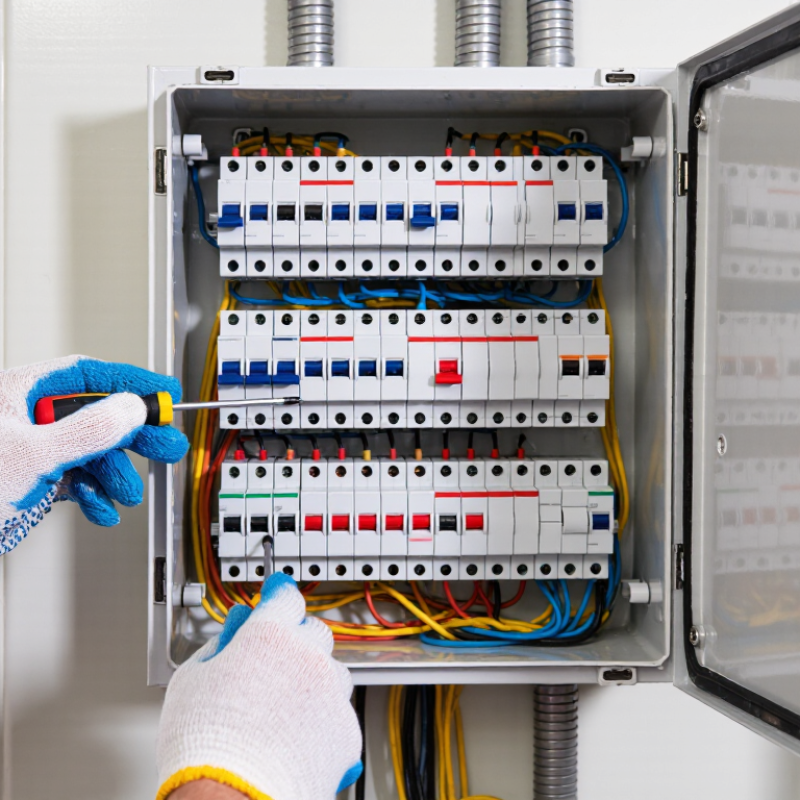
Define RCCBs: IEC 61008 Devices Detect Residual Current, Not Overload
An RCCB, or residual current circuit-breaker, monitors the current flowing through the live and neutral conductors. Under normal conditions, those currents balance. If some current leaks to earth, the difference can trip the device. It responds to residual current. It does not protect against overloads or short circuits.
That distinction matters when choosing equipment. An RCCB covered by IEC 61008 must be paired with suitable overcurrent protection, such as a circuit-breaker or fuse. For example, a heater drawing too much current may overheat its wiring without creating an earth leakage that trips the RCCB. Two different protections are needed. Check that their ratings and coordination suit the circuit.
The right RCCB also depends on the expected current waveform. Type AC detects sinusoidal residual current; Type A also responds to pulsating DC, which some electronic appliances can produce. Other types may suit particular equipment, but the appliance instructions and a qualified electrician should guide that choice. Consider the device’s rated current, residual operating current, number of poles, and installation conditions. A label alone can be misleading. In real installations, loads change, and choosing by sensitivity alone is an easy mistake.
Match Rated Current and Poles to the Supply; Common Ratings Span 25–100 A
Choosing the right RCCB starts with matching its rated current and pole configuration to the electrical supply. Common rated-current options range from 25 A to 100 A. The correct value depends on the circuit’s expected load and coordination with the upstream overcurrent protective device. A higher rating is not automatically safer. Rated current indicates what the device can carry; it is not the current that triggers residual-current disconnection.
Check the supply before selecting poles. A single-phase circuit commonly uses a two-pole RCCB, while a three-phase circuit may require four poles, including a neutral where applicable. The arrangement must suit the actual wiring. Also confirm that the RCCB’s rated current is appropriate for the connected circuit and its protective devices. An RCCB detects residual current, but does not provide overload or short-circuit protection by itself. Details matter.
Tips: Read the circuit schedule and device markings, then verify the supply type and expected load. Do not choose solely by matching an existing unit; the original selection may need review. If the wiring or load is unclear, ask a qualified electrician to check the design and installation requirements. A quick visual guess can miss important differences.
Select Sensitivity: 30 mA for Additional Protection; 300 mA for Fire Protection
Choosing RCCB sensitivity means matching the trip threshold to the hazard. A 30 mA RCCB provides additional protection against electric shock on applicable circuits. IEC 60364-4-41 specifies this limit for defined situations, including certain socket-outlet circuits. It is not a guarantee against injury. IEC 60479-1 explains that electric current’s effects depend on both magnitude and exposure time. A wet bathroom floor, damaged cable, or faulty appliance can make a small leakage current more concerning. The details matter.
For fire protection, 300 mA devices are commonly used where installation conditions and local design rules call for higher-threshold residual-current protection. IEC 60364-4-42 addresses protection against thermal effects and fire risks. A 300 mA RCCB is not a substitute for correct wiring, overcurrent protection, or appropriate device coordination. It is easy to focus on the number alone. I would also check the circuit layout, earthing arrangement, and manufacturer’s trip-time specifications with a qualified electrician. The standards guide selection, but a real installation can be less tidy than a diagram.
Choose Type AC, A, F, or B to Suit the Load’s Residual-Current Waveform
Choosing an RCCB starts with the residual-current waveform your equipment can produce. Type AC responds to sinusoidal alternating current, often found with simple resistive loads. Type A also detects pulsating direct current, which can occur in appliances with electronic controls. Check the equipment instructions; a familiar appliance may contain a less obvious electronic load.
Type F is designed for certain mixed-frequency currents, including those from some single-phase inverter appliances and variable-speed drives. Type B covers a broader range, including smooth direct current, and may be specified for particular charging or power-conversion equipment. That detail matters. The borderline cases are easy to misread, so do not choose by appliance name alone. Confirm the expected waveform and RCCB type in the equipment documentation, or ask a qualified electrician to assess the circuit.
Tips: Match the RCCB type to the load, then verify rated current and residual operating sensitivity for the installation. An RCCB does not provide overload or short-circuit protection by itself. If several electronic loads share a circuit, their combined leakage can affect selection. A little uncertainty is a reason to check, not guess.
Check Coordination and Trip Times: IEC 61008 Allows up to 300 ms at IΔn
How to Choose the Right RCCB for Your Needs?
Check coordination and trip times before selecting an RCCB. Under IEC 61008, a general, non-delayed RCCB may take up to 300 milliseconds to trip at its rated residual operating current, IΔn. That is a maximum limit, not a target for every installation. At higher fault currents, the permitted trip time is shorter. Check the device’s marking and technical data, since its type and rating affect the figures. Small details matter.
Coordination is just as important. If two RCCBs protect the same circuit path, the downstream device should generally trip first, limiting the loss of power. This often requires comparing rated residual currents and checking whether an upstream device has a time delay. Do not assume that different ratings alone guarantee selectivity. An electrician can assess the circuit layout and confirm coordination against the applicable product data and installation requirements. A suitable tester can then measure actual trip performance on site. A neat calculation can still miss wiring conditions or leakage from connected equipment; that deserves a second look. Tripping too slowly is not acceptable, but nuisance trips are not useful either.