Choosing the best giant lanterns manufacturer in China takes more than comparing colorful photos. A strong supplier should explain how its designs become durable, well-finished displays. Look for clear project examples, material details, and evidence of consistent quality checks. Details matter.
Review the frame, covering, lighting, and intended display conditions. Ask whether the structure suits indoor use, outdoor events, or both. A reliable manufacturer will discuss these choices plainly, rather than promising that one design fits every setting. Ask for proof. Request recent project images, production specifications, and a clear description of how quality is checked before shipment. If possible, review a sample of the fabric, painted surface, or lighting components. Small finishes can look different in close-up.
Customization also deserves careful discussion. Share dimensions, artwork, color references, installation plans, and delivery timing early. Then ask how design changes affect cost and production schedules. Clear answers make comparisons fairer. A responsive team should identify practical limits and flag details that need confirmation. No checklist is perfect. Communication, workmanship, and after-sales support can vary between projects, even with an experienced supplier. Treat claims as a starting point, not a guarantee. This guide explores how to assess Chinese manufacturers, compare their capabilities, and choose giant lanterns suited to your event, budget, and display needs.
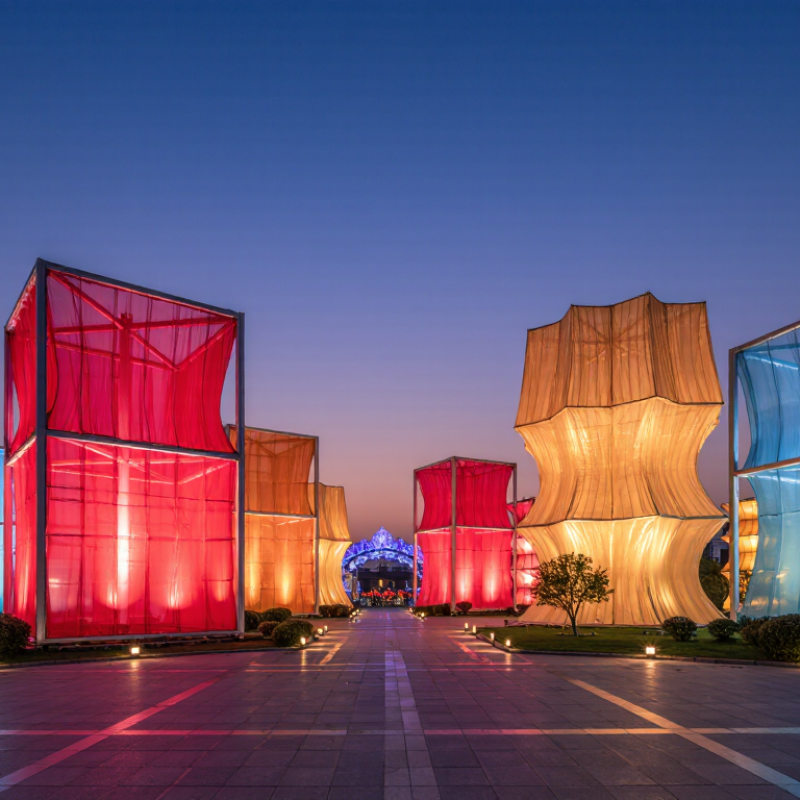
A giant lantern is a three-dimensional illuminated structure, not simply a large fabric shade. Its scale may range from a few meters to a display spanning an entire plaza. That size affects transport, assembly, wind exposure, and viewing distance. A practical design starts with a measured site plan. Details matter.
Inside, a metal framework—often made from steel or aluminum—supports the shape and distributes its weight. Joint design, access for assembly, and outdoor conditions deserve careful review. A lantern that looks stable in a rendering may behave differently in wind. The fabric skin should fit the frame without excessive tension, while allowing light to pass evenly. Color, seam placement, and surface finish all change the final appearance.
LED modules sit inside the structure, where spacing and heat management help prevent bright spots and uneven color. The U.S. Department of Energy’s Energy Saver guidance says LEDs use at least 75% less energy and last up to 25 times longer than incandescent lighting. That comparison is useful, though real performance depends on the complete installation. Not always straightforward. Ask for clear specifications covering LED power, access for maintenance, fabric type, frame material, and tested outdoor conditions. Even a small service opening can improve repairs, though it may interrupt a perfectly smooth surface.
Best Giant Lanterns Manufacturer in China
How Chinese Makers Build Lanterns with Steel Frames and LED Lighting
A giant lantern starts with a load-bearing steel frame. Makers cut and bend steel tubes, then join them into a skeleton matching the design. Cross-bracing helps the structure resist movement during assembly and display. The frame is checked before fabric or other coverings are fitted. A weak joint may stay hidden until the lantern is lifted. That is one detail worth questioning at every production stage.
LEDs bring color and light without the heat of many traditional bulbs. The U.S. Department of Energy reports that LEDs use at least 75% less energy and last up to 25 times longer than incandescent lighting. Those figures describe general lighting, not a guarantee for every lantern. Wiring layout, ventilation, moisture protection, and operating hours affect real-world performance. Makers should test illuminated sections before closing the covering, then inspect connections and cable routes. Brightness alone is not enough; uneven light can leave visible patches across a large surface.
Tips: Ask for frame dimensions, lighting specifications, and photos of a full-size assembly test. Confirm how the lantern will be anchored. A polished sample can still hide installation problems.
Best Giant Lanterns Manufacturer in China
What IP65 Means for Outdoor Lanterns: Dust-Tight and Water-Jet Protection
For a giant outdoor lantern, IP65 indicates two specific levels of protection. The first digit, 6, means the enclosure is dust-tight under testing. The second digit, 5, means it can withstand water jets from different directions. Rain and splashing are expected conditions. Submersion is not. A lantern with this rating should not be left underwater or treated as flood-proof. On a large installation, inspect seams, cable entries, and access panels, since these details can affect real-world protection.
Tips: Check that connectors and cable glands also suit outdoor use. Keep drainage paths clear, and look for cracked seals before installation. A rating can feel reassuring, but it does not replace careful assembly.
When selecting a giant lantern, ask how the finished product was tested, not just which rating appears on a component. Water may enter through a poorly closed service hatch, even when the main enclosure is well designed. After installation, check for loose fittings and damaged seals, especially following transport or strong winds. IP65 is useful protection, not a promise of zero maintenance. That distinction is easy to overlook.
The first digit indicates protection against solid objects and dust; the second indicates protection against water. IP65 means dust-tight (6) and protected against water jets (5). The digits are classification levels, not linear measurements.
For giant lanterns, a 50,000-hour LED rating sounds reassuring, but it needs context. At 12 hours of nightly use, 50,000 hours equals about 11.4 years. That is a calculation, not a promise that the complete lantern will last that long.
The U.S. Department of Energy’s report, LED Luminaire Lifetime: Recommendations for Testing and Reporting, stresses assessing the luminaire as a system. LEDs, drivers, wiring, and protective covers can age at different rates.
Ask whether the claim refers to L70, the point when light output falls to 70% of its initial level. IES LM-80 measures LED package lumen maintenance under specified conditions; IES TM-21 uses those results to project maintenance. Request the test duration, temperatures, and projection details—not just a sales sheet stating “50,000 hours.”
Details matter. On a large outdoor lantern, heat trapped behind decorative panels, moisture at cable joints, and long nightly operating hours can affect real-world performance. A careful manufacturer should explain how its complete product was tested and what the warranty covers. Even then, a long rating is an estimate, not a guarantee of zero failures.
Choosing the best giant lanterns manufacturer in China takes more than comparing catalog photos. Ask whether the team can work from your dimensions, colors, and installation plan. A useful supplier will explain how design changes affect frame weight, fabric tension, lighting, and assembly time. Request a scale drawing and close-up photos of finished details before approving production. Small seams matter.
Safety deserves specific questions. Check how the lantern frame is secured, how electrical components are protected, and whether materials suit the display location. Outdoor installations need particular attention to wind exposure and anchoring. Ask for relevant test records and clear operating instructions; a confident sales reply alone is not evidence. I have seen attractive mock-ups overlook access for repairs.
Tips: Compare written specifications, not just sample images. Confirm packing dimensions, replacement-part availability, and who handles damage claims before placing an order.
Export support can save time when details are agreed early. Ask for a production schedule, packing list, shipping options, and updates during inspection and dispatch. Confirm who prepares the export documents and how the lanterns are labeled for assembly. If answers remain vague, pause and request them in writing. Delivery estimates can shift, so leave room for delays rather than planning around the most optimistic date.
Use this evidence-based checklist to compare suppliers. It lists practical evaluation criteria rather than unverified supplier ratings or performance claims. Applicable safety and shipping requirements depend on the product design, destination, and project.
| Comparison Dimension | What to Compare | Evidence to Request | How to Verify |
|---|---|---|---|
| Custom Design | Ability to adapt the lantern’s shape, dimensions, colors, artwork, structure, and lighting layout to the project brief. | A written specification, dimensioned drawings or renderings, material list, and a record of revisions and approvals. | Check that drawings show the agreed dimensions, attachment points, access panels, and lighting arrangement before production. |
| Prototype and Approval Process | Whether the supplier defines approval stages for design, color, materials, lighting, and any physical sample or prototype. | A sample or prototype plan, approval checklist, production schedule, and written change-control process. | Confirm in writing which features are covered by each approval and how changes after approval affect cost and lead time. |
| Structure and Installation | Frame construction, joints, lifting or suspension points, anchoring method, installation sequence, and maintenance access. | Assembly drawings, installation instructions, component details, and project-specific structural calculations where required. | Have a qualified professional review structural suitability for the intended location and installation conditions; do not assume one design suits every site. |
| Electrical Safety | Power requirements, wiring and connections, lighting components, grounding or insulation approach, and protection from moisture where relevant. | Electrical specifications, component documentation, wiring diagrams, and test reports or certificates that identify the tested product and applicable standard. | Check that documentation matches the supplied configuration and destination-market requirements. A certificate for a component alone may not establish compliance of the complete lantern. |
| Materials and Weather Exposure | Fabric or covering, frame materials, coatings, seams, UV exposure considerations, and suitability for the expected indoor or outdoor environment. | Material specifications, care or maintenance instructions, and relevant test reports for claims such as water resistance or flame performance. | Match each claimed rating or performance result to the named material or finished assembly, test method, and intended use. Request project-specific confirmation for outdoor installations. |
| Quality Control | Inspection points for incoming materials, frame assembly, artwork, lighting, finishing, and final packing. | A quality-control plan, inspection checklist, defect-handling procedure, and sample inspection records where available. | Agree measurable acceptance criteria, inspection timing, photo documentation, and how nonconforming items will be corrected before placing the order. |
| Production and Delivery Planning | Quoted production stages, approval deadlines, packing time, dispatch arrangements, and contingency planning for schedule changes. | A dated production schedule, milestone definitions, packaging plan, and written quotation showing what is included or excluded. | Separate production lead time from transit time and confirm the delivery term, named place, and responsibility for each shipping stage. |
| Export Documentation | Experience preparing the shipment documents required for the agreed route, delivery term, and destination. | A proposed document list, such as commercial invoice, packing list, and transport document; request a certificate of origin only if needed for the shipment. | Confirm document details with the importer, freight forwarder, and relevant customs authorities. The buyer should verify tariff classification and import requirements for the destination. |
| Packing and Transport Protection | Protection against crushing, abrasion, moisture, and movement in transit, as well as whether the lantern ships assembled or in sections. | Packing specifications, package dimensions and weights, handling marks, and photos of comparable packing if available. | Confirm packaging is suitable for the chosen transport mode and that the packed dimensions, handling needs, and unloading equipment are compatible with the delivery site. |
| Communication and After-Sales Support | Clarity and timeliness of technical responses, a named project contact, spare-parts availability, and the process for handling defects or damage. | A communication schedule, written warranty terms, spare-parts list, and after-sales claim procedure. | Make sure warranty scope, exclusions, response process, and remedies are documented in the purchase agreement. |
Quality Commercial LED Lighting specializing in LED Tubes, LED Bulbs, LED Troffers, LED Door Kits, LED Retrofit Kits, LED Panels, LED Spot Lights, LED Wall Packs, LED Lamps, LED Drivers, LED Accessories, LED Lights, LED Sales, and LED Manufacturing. Headquartered in Atlanta, Georgia, USA.