2026 Best Commercial LED Strip Lights for Business Buyers
Choosing Commercial Led Strip Lights is not just a brightness decision. A café may need warm, dimmable light beneath a counter, while a warehouse needs durable strips and consistent illumination across long runs. Small details matter: voltage drop, connector quality, heat management, and whether the power supply can handle the installation. Still, a polished specification sheet can hide practical weaknesses.
The U.S. Department of Energy’s Energy Saver guidance reports that LED products use at least 75% less energy and can last up to 25 times longer than incandescent lighting. Those figures are useful benchmarks, not guarantees for every strip-light system. Results depend on the product, installation, operating hours, and comparison baseline. Dr. Nadarajah Narendran, a lighting researcher at RPI’s Lighting Research Center, has studied solid-state lighting; a practical takeaway from that work is to assess the complete system, not just the LED source. That means checking the driver, thermal design, optics, and controls alongside lumens and color temperature. Some buyers still overlook those parts. That can be costly.
This guide to the 2026 best commercial strip lights compares options through a business lens: light output, color quality, installation demands, controllability, and expected operating costs. It also asks an unglamorous question: will the product stay reliable after months of daily use? No single strip suits every site. The right choice should match the space, the maintenance plan, and the people who use it.
Define Commercial Strip Requirements: 24 V Systems, lm/W, and CRI ≥80
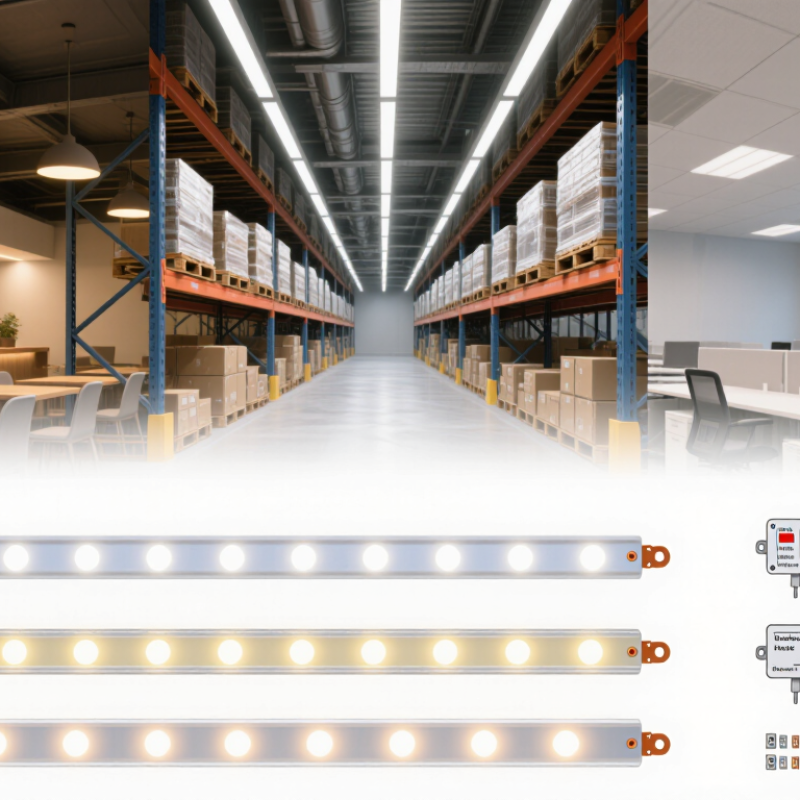
For commercial projects, specify 24 V LED strips when runs extend across shelves, counters, or ceiling coves.
The higher voltage can reduce current and help limit voltage drop compared with low-voltage alternatives, but it does not eliminate it. A 12-meter run may still show dimmer output near its far end if power enters from one side. Check the strip’s wattage per meter, total run length, and manufacturer’s feed-point guidance before installation. Measure the actual layout, not just the drawing.
Compare efficacy in lumens per watt, or lm/W, at the intended color temperature and output level. A high figure looks attractive on a datasheet, yet driver losses and heat can affect installed performance. Keep the driver accessible, and allow room for airflow above the aluminum channel. Small details matter. For most general commercial areas, CRI ≥80 is a sensible minimum for recognizable colors. Retail displays, food counters, and material samples may need CRI 90 or higher. Check the full specification, including color consistency and dimming compatibility; I have seen a good-looking sample behave differently once installed. That is worth testing on a short mock-up.
Compare Output and Color: Lumens per Meter, CRI, and R9 Values
Commercial buyers should compare LED strip output in lumens per meter, not total lumens alone. A 1,200-lumen-per-meter strip may look bright on paper, but a deep channel or frosted diffuser can reduce visible light. Compare products at the same color temperature and installation conditions. Check whether the stated output is measured before or after the diffuser. Small details matter.
CRI describes how naturally colors appear, but the general CRI score can hide weak reds. R9 measures saturated red rendering, which matters in food displays, retail clothing, and hospitality interiors. A strip with CRI 90 and a low R9 may render skin or red fabric less convincingly than expected. Review both values, plus the intended task. A neat spreadsheet can still mislead; I would not choose by one number.
Tips: Ask for test data at the actual operating temperature, and confirm whether output is rated per meter of strip or per installed run. For color-critical spaces, request a sample and inspect familiar objects under it. Specifications help, but the room may tell a different story.
Select Protection by IEC 60529: IP20, IP65, or IP67 Enclosures
For commercial LED strip lights, choose the IP rating for the actual cleaning and exposure conditions. Under IEC 60529, the first digit describes protection against solid objects and dust; the second describes water ingress. IP20 offers basic contact protection but no water protection. It can suit dry offices, display cases, and indoor coves. Not wet areas. IP65 is dust-tight and tested against water jets, making it a practical option near washdown zones when the product is installed as specified. It is not rated for immersion.
IP67 is dust-tight and tested for temporary immersion, commonly up to one metre for 30 minutes under specified test conditions. That does not make every installation suitable for a pool edge or standing water. Check the strip, power leads, connectors, end caps, and any joins; one unprotected connection can undermine the installation. Check every connection. Also confirm the rating applies to the complete assembly, not just the strip coating. A cut end may need a compatible sealed cap, and installation details matter. IP ratings do not describe resistance to heat, cleaning chemicals, or sunlight. Match protection to the site, then verify the product documentation and mounting instructions before ordering. A higher number is not automatically the better choice.
2026 Best Commercial LED Strip Lights for Business Buyers — Select Protection by IEC 60529: IP20, IP65, or IP67 Enclosures
The first digit indicates protection against solid objects or dust; the second indicates protection against water. IP20 provides level 2 solid-object protection and no water protection rating. IP65 is dust-tight and protected against water jets. IP67 is dust-tight and protected against temporary immersion under IEC 60529 test conditions. Choose a rating that matches the installation environment, and check that connectors and other system components have suitable protection too.
Verify Performance with IES LM-79 and LM-80/TM-21 Reports
For commercial buyers, test reports are more useful than broad efficiency claims.
An IES LM-79 report records measured electrical and photometric performance for a defined lighting product and test setup. Review input power, light output, efficacy, color characteristics, and operating conditions. Ask whether the tested LED strip matches the quoted model, length, driver, and installation method. Was it measured in an aluminum channel? That detail matters.
LM-80 reports track lumen maintenance for LED packages, arrays, or modules under specified conditions. TM-21 uses that data to project lumen maintenance; it does not guarantee the finished strip’s service life. Check the reported temperature and test duration, then compare them with the heat expected in your installation. A report can look impressive and still leave gaps. For example, a bare strip tested in open air may not reflect a long run inside a warm display case. Request documentation tied to the actual product configuration, and note any differences. Some uncertainty remains: real-world dimming, dust, and installation quality can affect performance beyond laboratory results.
Compare L70 Projections, Warranty Terms, and 50,000-Hour Costs
A 50,000-hour rating is not a promise that every strip will run flawlessly for 50,000 hours. Check the L70 projection: it estimates when output may fall to 70 percent of its initial level. Ask whether that estimate comes from documented testing, and whether it covers the strip, driver, or both. Those details matter in a warehouse aisle where dimmer light can affect inspection work.
Warranty terms deserve the same close reading. Confirm the coverage period, required installation conditions, and what happens if a section fails. A long warranty may still exclude labor or damage linked to unsuitable heat management. Keep the paperwork. It is easy to misplace.
Compare costs over the same 50,000-hour period. For example, 100 meters drawing 10 watts per meter uses 50,000 kilowatt-hours. At an assumed electricity rate of $0.15 per kilowatt-hour, that is $7,500 in energy, before driver losses, controls, and installation. At 12 hours daily for 300 days each year, 50,000 hours takes about 13.9 years. That projection may look neat on a spreadsheet; real operating schedules rarely stay neat. Include replacement labor and downtime, then check whether the quoted L70 and warranty actually support that service life.
2026 Best Commercial LED Strip Lights for Business Buyers - Compare L70 Projections, Warranty Terms, and 50,000-Hour Costs
A brand-neutral, illustrative comparison of three commercial LED strip-lighting scenarios. Figures are planning assumptions, not verified product specifications or supplier quotations.
| Planning scenario |
Input power |
Assumed system efficacy |
Initial light output |
Illustrative L70 projection |
Sample warranty term to request |
Upfront hardware cost per 100 m |
Energy cost over 50,000 hours |
Modeled 50,000-hour total |
| Entry-level, accent lighting |
9.6 W/m |
100 lm/W |
960 lm/m |
35,000 hours |
3 years; confirm coverage, labor, and pro-rata terms |
$500 |
$5,760 |
$6,260 |
| Balanced, general commercial use |
14.4 W/m |
120 lm/W |
1,728 lm/m |
50,000 hours |
5 years; confirm driver and strip coverage separately |
$800 |
$8,640 |
$9,440 |
| High-output, demanding applications |
19.2 W/m |
140 lm/W |
2,688 lm/m |
60,000 hours |
5 years; request written details on remedies and exclusions |
$1,100 |
$11,520 |
$12,620 |
Cost basis: Each scenario models 100 m operating for 50,000 hours at an electricity rate of $0.12/kWh. Energy cost is calculated from input watts × operating hours × electricity rate. The total adds the illustrative upfront hardware cost to energy cost.
Excluded from totals: Installation labor, controls, taxes, maintenance, disposal, financing, electricity-rate changes, and replacement costs. L70 describes the point at which output is projected to reach 70% of its initial value; it does not mean the light stops working at that point.
Verification: The L70 figures and warranty terms above are scenario inputs, not certified claims. Before purchase, request product-specific LM-80 test data and applicable TM-21 projections, along with the full written warranty. Confirm that the tested LED package, operating temperature, drive current, and installed configuration match the proposed system.